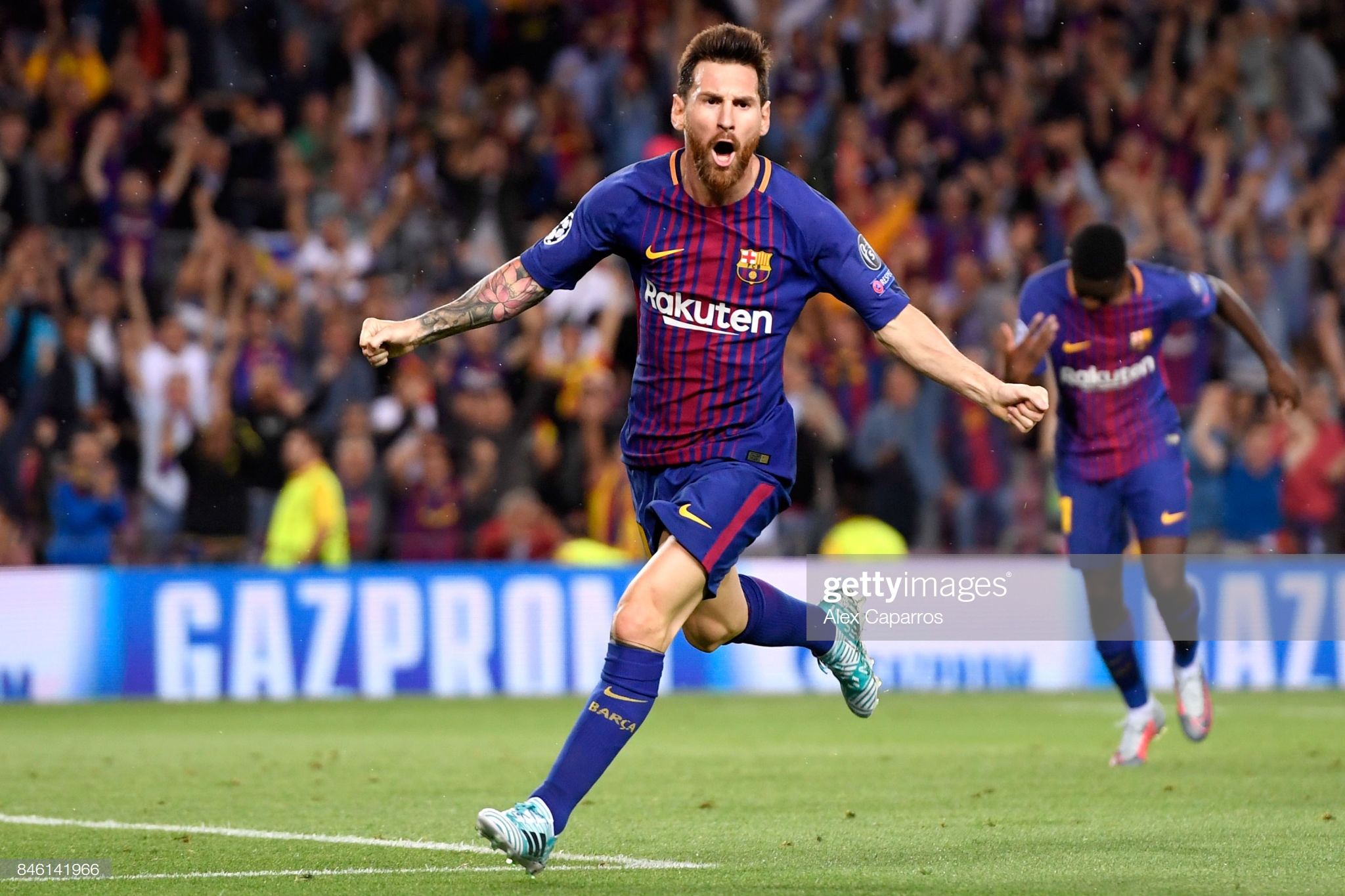

Lionel Andrés Messi Cuccittin born 24 June 1987) is an Argentine professional footballer who plays as a forward and captains both FC Barcelona and the Argentina national team. Often considered the best player in the world and widely regarded as one of the greatest players of all time, Messi has a record-tying five Ballon d’Or awards, four of which he won consecutively, and a record five European Golden Shoes. He has spent his entire professional career with Barcelona, where he has won a club-record 34 trophies, including ten La Liga titles, four UEFA Champions League trophies and six Copas del Rey. Both a prolific goalscorer and a creative playmaker, Messi holds the records for the most goals in La Liga (419), a La Liga and European league season (50), the most hat-tricks in the UEFA Champions League (8), and the most assists in La Liga (167) and the Copa América (11). He has scored over 690 senior career goals for club and country.
Born and raised in central Argentina, Messi was diagnosed with a growth hormone deficiency as a child. At age 13, he relocated to Spain to join Barcelona, who agreed to pay for his medical treatment. After a fast progression through Barcelona’s youth academy, Messi made his competitive debut aged 17 in October 2004. Despite being injury-prone during his early career, he established himself as an integral player for the club within the next three years, finishing 2007 as a finalist for both the Ballon d’Or and FIFA World Player of the Year award, a feat he repeated the following year. His first uninterrupted season was 2008–09, during which he helped Barcelona achieve the first treble in Spanish football. At 22 years old, Messi won the 2009 Ballon d’Or and the 2009 FIFA World Player of the Year award by record voting margins.
Three successful seasons followed, with Messi winning three consecutive FIFA Ballons d’Or, including an unprecedented fourth. During the 2011–12 season, he set the La Liga and European records for most goals scored in a single season, while establishing himself as Barcelona’s all-time top scorer in official competitions in March 2012. The following two seasons, Messi finished twice second for the Ballon d’Or behind Cristiano Ronaldo, his perceived career rival. Messi regained his best form during the 2014–15 campaign, breaking the all-time goalscoring records in both La Liga and the Champions League in November 2014,[note 3] and leading Barcelona to a historic second treble.
An Argentine international, Messi is his country’s all-time leading goalscorer. At youth level, he won the 2005 FIFA World Youth Championship, finishing the tournament with both the Golden Ball and Golden Shoe, and an Olympic gold medal at the 2008 Summer Olympics. His style of play as a diminutive, left-footed dribbler drew comparisons with his compatriot Diego Maradona, who described Messi as his successor. After his senior debut in August 2005, Messi became the youngest Argentine to play and score in a FIFA World Cup during the 2006 edition, and reached the final of the 2007 Copa América, where he was named young player of the tournament. As the squad’s captain from August 2011, he led Argentina to three consecutive finals: the 2014 FIFA World Cup, for which he won the Golden Ball, and the 2015 and 2016 Copas América. After announcing his international retirement in 2016, he reversed his decision and led his country to qualification for the 2018 FIFA World Cup.
EARLY LIFE
Lionel Andrés Messi was born on 24 June 1987 in Rosario, the third of four children of Jorge Messi, a steel factory manager, and his wife Celia Cuccittini, who worked in a magnet manufacturing workshop. On his father’s side, he is of Italian and Spanishdescent, the great-grandson of immigrants from the northcentral Adriatic Marche region of Italy and Catalonia, and on his mother’s side, he has primarily Italian ancestry.[5] Growing up in a tight-knit, football-loving family, “Leo” developed a passion for the sport from an early age, playing constantly with his older brothers, Rodrigo and Matías, and his cousins, Maximiliano and Emanuel Biancucchi, both of whom became professional footballers. At the age of four he joined local club Grandoli, where he was coached by his father, though his earliest influence as a player came from his maternal grandmother, Celia, who accompanied him to training and matches.He was greatly affected by her death, shortly before his eleventh birthday; since then, as a devout Catholic, he has celebrated his goals by looking up and pointing to the sky in tribute of his grandmother.”When you saw him you would think: this kid can’t play ball. He’s a dwarf, he’s too fragile, too small. But immediately you’d realise that he was born different, that he was a phenomenon and that he was going to be something impressive.”
A lifelong supporter of Newell’s Old Boys, Messi joined the Rosario club when he was six years old. During the six years he played for Newell’s, he scored almost 500 goals as a member of “The Machine of ’87”, the near-unbeatable youth side named for the year of their birth, and regularly entertained crowds by performing ball tricks during half-time of the first team’s home games.However, his future as a professional player was threatened when, at age 10, he was diagnosed with a growth hormone deficiency. As his father’s health insurance covered only two years of growth hormone treatment, which cost at least $1,000 per month, Newell’s agreed to contribute, but later reneged on their promise. He was scouted by Buenos Aires club River Plate, whose playmaker, Pablo Aimar, he idolised, but they were also unable to pay for his treatment due to the country’s economic collaps. His goalscoring idol growing up was Ronaldo, with Messi calling him “the best forward I’ve ever seen”.
Messi enrolled at Barcelona’s youth academy, La Masia, at age 13
As the Messi family had relatives in Catalonia, they sought to arrange a trial with Barcelona in September 2000. First team director Charly Rexachimmediately wanted to sign him, but the board of directors hesitated; at the time it was highly unusual for European clubs to sign foreign players of such a young age. On 14 December, an ultimatum was issued for Barcelona to prove their commitment, and Rexach, with no other paper at hand, offered a contract on a paper napkin. In February 2001, the family relocated to Barcelona, where they moved into an apartment near the club’s stadium, Camp Nou. During his first year in Spain, Messi rarely played with the Infantiles due to a transfer conflict with Newell’s; as a foreigner, he could only be fielded in friendlies and the Catalan league. Without football, he struggled to integrate into the team; already reserved by nature, he was so quiet that his teammates initially believed he was mute. At home, he suffered from homesickness after his mother moved back to Rosario with his brothers and little sister, María Sol, while he stayed in Barcelona with his father.
After a year at Barcelona’s youth academy, La Masia, Messi was finally enrolled in the Royal Spanish Football Federation (RFEF) in February 2002. Now playing in all competitions, he befriended his teammates, among whom were Cesc Fàbregas and Gerard Piqué. After completing his growth hormone treatment aged 14, Messi became an integral part of the “Baby Dream Team”, Barcelona’s greatest-ever youth side. During his first full season (2002–03), he was top scorer with 36 goals in 30 games for the Cadetes A, who won an unprecedented treble of the league and both the Spanish and Catalan cups. The Copa Catalunya final, a 4–1 victory over Espanyol, became known in club lore as the partido de la máscara, the final of the mask. A week after suffering a broken cheekbone during a league match, Messi was allowed to start the game on the condition that he wear a plastic protector; soon hindered by the mask, he took it off and scored two goals in 10 minutes before his substitution. At the close of the season, he received an offer to join Arsenal, his first from a foreign club, but while Fàbregas and Piqué soon left for England, he chose to remain in Barcelona.
CLUB GOALS
Club
As of match played 19 May 2019
| Club | Season | League | Copa del Rey | Champions League | Other | Total | |||||
|---|---|---|---|---|---|---|---|---|---|---|---|
| Division | Apps | Goals | Apps | Goals | Apps | Goals | Apps | Goals | Apps | Goals | |
| Barcelona C | 2003–04[535] | Tercera División | 10 | 5 | — | — | — | 10 | 5 | ||
| Barcelona B | 2003–04[44] | Segunda División B | 5 | 0 | — | — | — | 5 | 0 | ||
| 2004–05[45] | Segunda División B | 17 | 6 | — | — | — | 17 | 6 | |||
| Total | 22 | 6 | — | — | — | 22 | 6 | ||||
| Barcelona | 2004–05[45] | La Liga | 7 | 1 | 1 | 0 | 1 | 0 | — | 9 | 1 |
| 2005–06[59] | La Liga | 17 | 6 | 2 | 1 | 6 | 1 | 0 | 0 | 25 | 8 |
| 2006–07[62] | La Liga | 26 | 14 | 2 | 2 | 5 | 1 | 3[b] | 0 | 36 | 17 |
| 2007–08[77] | La Liga | 28 | 10 | 3 | 0 | 9 | 6 | — | 40 | 16 | |
| 2008–09[85] | La Liga | 31 | 23 | 8 | 6 | 12 | 9 | — | 51 | 38 | |
| 2009–10[98] | La Liga | 35 | 34 | 3 | 1 | 11 | 8 | 4[c] | 4 | 53 | 47 |
| 2010–11[114] | La Liga | 33 | 31 | 7 | 7 | 13 | 12 | 2[d] | 3 | 55 | 53 |
| 2011–12[121] | La Liga | 37 | 50 | 7 | 3 | 11 | 14 | 5[e] | 6 | 60 | 73 |
| 2012–13[163] | La Liga | 32 | 46 | 5 | 4 | 11 | 8 | 2[d] | 2 | 50 | 60 |
| 2013–14[171] | La Liga | 31 | 28 | 6 | 5 | 7 | 8 | 2[d] | 0 | 46 | 41 |
| 2014–15[187] | La Liga | 38 | 43 | 6 | 5 | 13 | 10 | — | 57 | 58 | |
| 2015–16[536] | La Liga | 33 | 26 | 5 | 5 | 7 | 6 | 4[f] | 4 | 49 | 41 |
| 2016–17[537] | La Liga | 34 | 37 | 7 | 5 | 9 | 11 | 2[d] | 1 | 52 | 54 |
| 2017–18[538] | La Liga | 36 | 34 | 6 | 4 | 10 | 6 | 2[d] | 1 | 54 | 45 |
| 2018–19[539] | La Liga | 34 | 36 | 4 | 2 | 10 | 12 | 1[d] | 0 | 49 | 50 |
| Total | 452 | 419 | 72 | 50 | 135 | 112 | 27 | 21 | 686 | 602 | |
| Career total | 484 | 430 | 72 | 50 | 135 | 112 | 27 | 21 | 718 | 613 |

 Vlog
Vlog 